Advanced Certificate in Data Science & Machine Learning
Go from Python and statistics to machine learning models you can deploy, with projects on real business data.
- Eight portfolio projects
- Indian datasets
- Live doubt-clearing
- Statistics done right
60% seats filled · Applications close 15 December 2026
Speak to a programme expert
- Duration
- 9 months
- Mode
- Online + campus immersion
- Schedule
- Sundays, 10 am – 1 pm
- Programme fee
- ₹1,40,000 + GST
- Eligibility
- Graduates with maths in Class 12
- Starts
- 7 February 2027

Programme overview
The Advanced Certificate in Data Science & Machine Learning builds the complete data-science toolkit — Python, statistics, SQL, machine learning and experimentation — and then teaches the part most courses skip: getting models into the hands of the people who make decisions.
You’ll work through a project every module on Indian datasets from agriculture, health, energy and finance, publish your work on GitHub and finish with an end-to-end capstone that goes from raw data to a deployed app and a stakeholder presentation.
Who is this programme for?
Eligibility: Graduates with maths in Class 12.
Graduates starting out
Engineering, science, commerce and economics graduates who want a first job in data.
Working professionals switching careers
People in IT support, testing, finance or operations ready to move into data roles.
Analysts levelling up
Excel and BI analysts who want to add Python, statistics and machine learning.
Why this matters now
Key benefits
Learn the whole workflow
Go from a messy CSV to a deployed model, not just the modelling step.
Master statistics properly
Understand sampling, testing and uncertainty so your conclusions stand up.
Write production-quality code
Use Git, functions and tests so your notebooks become reusable projects.
Run real experiments
Design A/B tests and causal analyses that answer “did it work?”.
Communicate with impact
Turn analysis into clear charts, apps and recommendations.
Get job-ready
Resume reviews, portfolio feedback and mock technical interviews.
Programme highlights
Eight portfolio projects
One graded project per module, published on GitHub.
Indian datasets
Agriculture, power, health and lending data, anonymised where needed.
Live doubt-clearing
Daily mentor hours for code and concept questions.
Statistics done right
A full module on inference, not a two-hour crash course.
Deployment included
Ship apps with Streamlit and model APIs before you graduate.
Hackathons
Quarterly 48-hour data challenges with industry judges.
Career services
Resume clinics, mock interviews and hiring-partner drives.
Alumni community
An active network of data professionals across Indian cities.
Curriculum
A practical, module-by-module journey. Each module ends with a case study or hands-on assignment.
01 Python for data science
- Python syntax, functions and notebooks
- Data wrangling with pandas
- Charts with Matplotlib and Seaborn
- Git and reproducible projects
02 Statistics and probability
- Distributions and sampling
- Hypothesis tests and p-values
- Confidence intervals and bootstrapping
- Bayesian thinking basics
03 SQL and data engineering basics
- Joins, CTEs and window functions
- Data warehouses and ETL
- Automated data-quality checks
- Pulling data from APIs and large files
04 Machine learning
- Regression and classification
- Tree ensembles and XGBoost
- Cross-validation and hyperparameter tuning
- Explaining models with SHAP
05 Campus immersion I
- Live sessions with faculty on campus
- Peer learning and group work
- Storytelling and presentation workshop
06 Advanced modelling
- Time-series forecasting
- Clustering and segmentation
- Text analytics
- An introduction to neural networks
07 Experimentation and causal inference
- A/B test design and sample size
- Difference-in-differences
- Uplift modelling
- Pitfalls: peeking and novelty effects
08 Deployment and communication
- Interactive apps with Streamlit
- Model APIs and scheduled jobs
- Monitoring models after launch
- Storytelling with data for stakeholders
09 Capstone project
- Source and clean a real dataset
- Model, validate and interpret
- Deploy an app for end users
- Present findings to an industry panel
10 Campus immersion II
- Capstone presentation to a faculty panel
- Career guidance and networking
- Certificate ceremony
Real-world case studies
A crop-insurance scheme
Satellite and rainfall data used to estimate yield loss by district.
An online learning platform
Predicting which students will drop out in the first two weeks.
A multi-city hospital group
Forecasting bed occupancy to plan staff rosters a week ahead.
An electricity distribution company
Spotting meter tampering from unusual consumption patterns.
A cloud-kitchen chain
Order forecasts per outlet that cut food waste by a fifth.
A housing-finance company
Property-value models that speed up loan approvals in tier-2 cities.
Career pathways
Roles our learners grow into, with typical salary ranges in India.
| Role | Typical salary |
|---|---|
| Data analyst | ₹5–12 LPA |
| Data scientist | ₹8–22 LPA |
| Decision scientist | ₹10–24 LPA |
| Machine learning engineer | ₹12–28 LPA |
| Analytics consultant | ₹9–20 LPA |
| Senior data scientist | ₹22–40 LPA |
Salary ranges are indicative, based on public job-market data. The programme does not guarantee placement.
Tools you’ll use
| Tool | What you’ll use it for |
|---|---|
| Python (pandas, NumPy) | Data cleaning, analysis and modelling |
| Jupyter | Interactive notebooks for exploration |
| PostgreSQL | Querying and modelling relational data |
| scikit-learn / XGBoost | Machine learning models |
| Streamlit | Turning models into shareable apps |
| Tableau | Dashboards for business audiences |
| Git / GitHub | Version control and portfolio |
Programme outcomes
By the end of the programme you will be able to:
01
Clean, explore and visualise real-world datasets in Python
02
Apply statistical tests and quantify uncertainty correctly
03
Build, tune and explain machine learning models
04
Design experiments and estimate causal effects
05
Deploy models as apps and APIs others can use
06
Present data-driven recommendations to non-technical audiences
Admission process
Apply online
Fill in the short application form and pay the application fee.
Eligibility review
Our team checks your education and experience.
Selection
A short call or interview with the programme committee.
Offer letter
Selected candidates receive an offer by email.
Confirm your seat
Pay the first instalment or set up EMI to enrol.
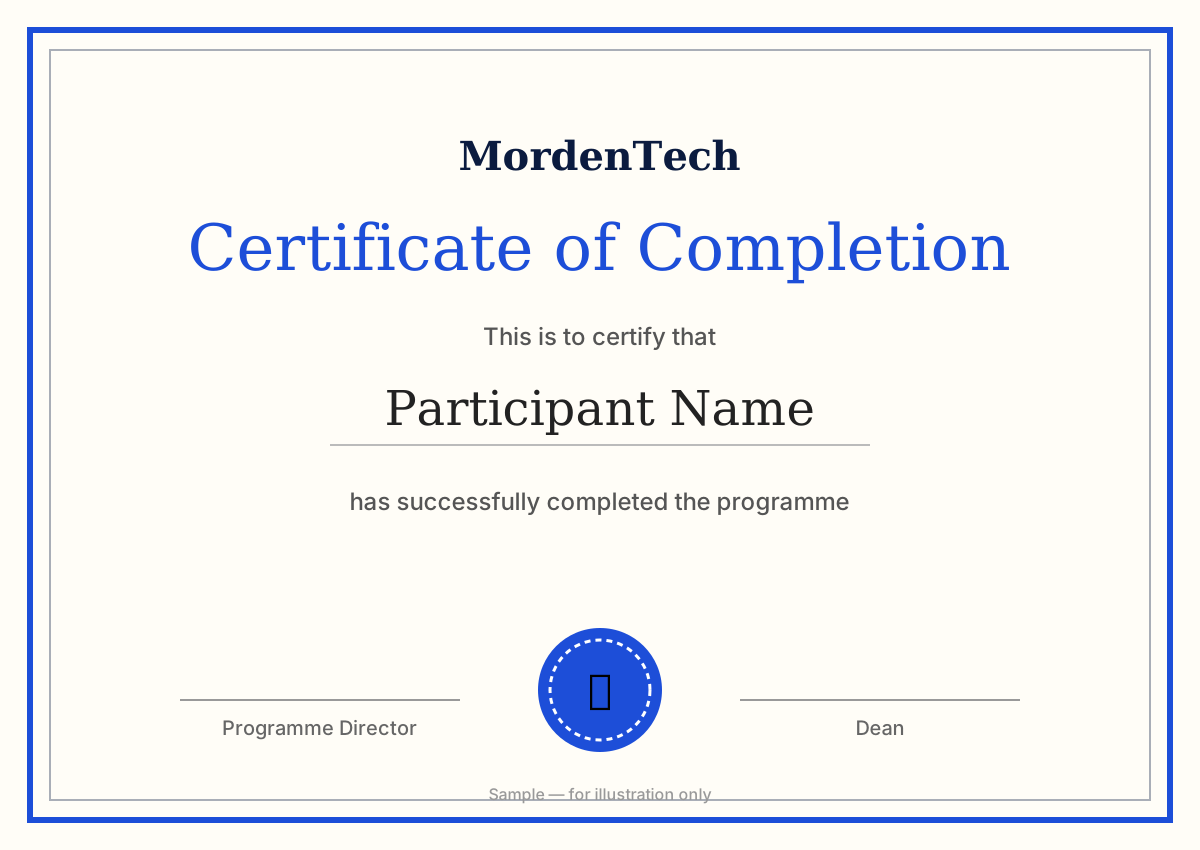
Earn your certificate
Successful participants receive a certificate of completion from MordenTech, a credential recognised by employers across industries.
Awarded to participants who meet the attendance and assessment requirements. The certificate shown is a sample, for illustration only.

Campus immersion
Spend two to three days on the MordenTech campus: live sessions with faculty, a storytelling workshop, your capstone presentation, and time to network with classmates and industry guests.
The immersion is optional and costs ₹5,000–₹10,000, including food and stay on campus. Travel and personal expenses are not included.
Fee structure
| Item | Amount |
|---|---|
| Application fee (one-time) | ₹1,000 |
| Programme fee | ₹1,40,000 |
| GST (18%) | ₹25,200 |
| Total programme fee | ₹1,65,200 |
The total excludes the application fee. No refunds after the programme starts; see the refund policy.
Payment schedule
| Instalment | Amount | When |
|---|---|---|
| First instalment | ₹70,000 + GST | Within 7 days of your offer letter |
| Second instalment | ₹70,000 + GST | Before the halfway point of the programme |
Easy EMI options
Pay for Data Science & ML in easy monthly instalments through our lending partners.
24 months
- Low-cost EMI
- Smallest monthly amount
- Subject to lender approval
Programme faculty
Learn from faculty and practitioners who teach what they do.

Prof. Ritu Sharma
Twenty years of research in machine learning and operations analytics.

Dr. Meera Nair
Works on natural language processing and responsible AI.
What our learners say
“The capstone was close to my real job — I used the model at work before the programme ended.”
“Weekend classes made it possible alongside a demanding role, and the faculty were superb.”
“The campus immersion and peer network were worth it on their own.”
In the news

MordenTech launches AI programmes for working professionals
New live online programmes in AI for commerce, data science and generative AI.

Faculty win national award for research in AI
The award recognises work on language models for Indian languages.

First batch completes campus immersion
Over 120 professionals presented capstone projects to a faculty panel.
Frequently asked questions
I have never coded. Can I join?
Do I need a maths degree?
Is there placement support?
How many hours a week does it take?
Are the programmes online?
Who can apply?
Download the brochure
Get the full curriculum, fee details and faculty profiles in your inbox.